
Flagship · Cited narrative

A family story you can actually trust — every sentence sourced.

We write your ancestors' story in plain prose and fuse three kinds of evidence — your DNA matches, archival records, and ancient DNA. Every factual sentence ends in a footnote. If we can't source a claim, we don't write it.

Illustrative example — not real data
Illustrative — not real data

James McKinley

A paternal-line ancestor who settled the North Carolina backcountry, reconstructed step by step from a federal census, a colonial port book, a living DNA match, and an ancient genome — nothing guessed.

James was an established head of household in Rowan County, North Carolina, by about 1791 — Scots-Irish Presbyterian stock who came down the Great Wagon Road.[1] A generation earlier the line crossed the Atlantic: an ancestor departed Belfast in 1738 aboard the George and Anne.[2] A living descendant in Ballymena, County Antrim shares a 187 cM segment with your kit — a named, consented match that anchors the Ulster origin, not an estimate.[3] The direct paternal line carries Y-haplogroup R-L21, the dominant Atlantic-Celtic paternal lineage of Ireland and Britain.[4] That same R-L21 line turns up in the Rathlin Island ancient genome off the Antrim coast — a Bronze Age burial dated to roughly 2000 BCE, present on the island some four thousand years before the ship manifest.[5]
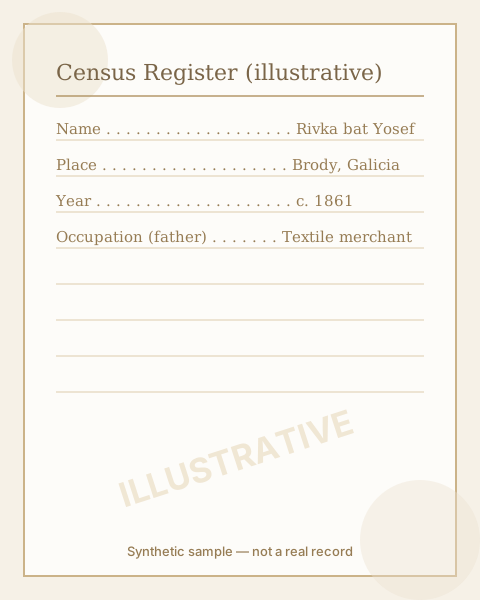
Illustrative federal census page showing James McKinley of Rowan County, North Carolina — a synthetic sample, not a real historical document.
Source verifiedIllustrative1800 U.S. Federal Census, Rowan County, NC (illustrative)
  1. [1]1800 U.S. Federal Census, Rowan County, NC
  2. [2]PRONI Belfast Port Books, 1738 — George and AnneView source
  3. [3]DNA match — 187 cM segment, Ballymena, Co. Antrim (consented)View source
  4. [4]Y-haplogroup R-L21 (Atlantic-Celtic paternal lineage)
  5. [5]Rathlin Island ancient genome, Ireland ~2000 BCE (Cassidy et al. 2016, Nature)View source

Continue this line back four more generations.

Unlock with your kit

What this means for your family

A story, not a spreadsheet — and you can check every word

It reads like a story

Your family appears as people with places and dates, written in warm prose you can read aloud at the dinner table — not a wall of match percentages.

Every word has a receipt

Each sentence carries a numbered footnote to a real birth register, census, DNA match, or ancient sample. Click it; see the source.

We would rather say nothing than guess

If a fact cannot be tied to a source, it never makes it onto the page. No confident-sounding fabrication, ever.

Three kinds of evidence, one story

Living DNA matches, paper records, and ancient DNA are fused into a single readable line of descent — not three disconnected tools.

Names, kept whole

A name in any alphabet stays itself — rendered faithfully, with its original spelling preserved, not flattened to a guess.

It grows as evidence grows

New matches and newly indexed records extend the same sourced narrative over time. The story is never frozen.

See what 'cited' means

An illustrative, fully-sourced excerpt

This example is fictional and clearly marked. Notice that every sentence ends in a numbered citation, and the sources span a birth register, a census, a haplogroup, a living DNA match, and an ancient sample. Public samples never use real customer data.

Illustrative — not real data

James McKinley

A paternal-line ancestor who settled the North Carolina backcountry, reconstructed step by step from a federal census, a colonial port book, a living DNA match, and an ancient genome — nothing guessed.

James was an established head of household in Rowan County, North Carolina, by about 1791 — Scots-Irish Presbyterian stock who came down the Great Wagon Road.[1] A generation earlier the line crossed the Atlantic: an ancestor departed Belfast in 1738 aboard the George and Anne.[2] A living descendant in Ballymena, County Antrim shares a 187 cM segment with your kit — a named, consented match that anchors the Ulster origin, not an estimate.[3] The direct paternal line carries Y-haplogroup R-L21, the dominant Atlantic-Celtic paternal lineage of Ireland and Britain.[4] That same R-L21 line turns up in the Rathlin Island ancient genome off the Antrim coast — a Bronze Age burial dated to roughly 2000 BCE, present on the island some four thousand years before the ship manifest.[5]

Illustrative federal census page showing James McKinley of Rowan County, North Carolina — a synthetic sample, not a real historical document.
Source verifiedIllustrative1800 U.S. Federal Census, Rowan County, NC (illustrative)
  1. [1]1800 U.S. Federal Census, Rowan County, NC
  2. [2]PRONI Belfast Port Books, 1738 — George and AnneView source
  3. [3]DNA match — 187 cM segment, Ballymena, Co. Antrim (consented)View source
  4. [4]Y-haplogroup R-L21 (Atlantic-Celtic paternal lineage)
  5. [5]Rathlin Island ancient genome, Ireland ~2000 BCE (Cassidy et al. 2016, Nature)View source

Continue this line back four more generations.

Unlock with your kit

The difference

Why this isn’t an “AI story” feature

ServiceWhat they doWhat we do
Ancestry "AI Stories"Narrates one record at a time, walled inside Ancestry's own data, with no citations you can follow and no DNA fused in.Fuses DNA + records + ancient DNA across sources, and footnotes every sentence so you can verify it.
MyHeritage AI BiographerGenerates a biography from tree facts, with no DNA evidence and no ancient-DNA context for your specific line.Grounds the story in your actual DNA matches and ties the deep line to ancient samples.
Generic LLM "write my family history"Produces fluent prose that invents plausible-sounding details — the exact failure mode for genealogy.Drops any sentence it cannot source. Fabrication is structurally impossible, not just discouraged.

Others generate a story. We assemble a sourced one — and show you every receipt.

Start with your free kit

Add a DNA file or a GEDCOM and we begin building your sourced narrative — the first kit is free.