
What your DNA still remembers

Every American family walked a different road. Here’s yours.

Whether your line came over on the Mayflower, through Ellis Island, or across the Rio Grande, we trace the documented route — not just a region — and back every step with a record, a DNA match, or an ancient sample you can open yourself.

Illustrative archival portrait placeholder — a synthetic sample, not a real person.
Reconstructed migration path — derived from a paternal-line DNA match and a port-book record. Illustrative; a real route is drawn only from your kit.

One cited line, shown in full

This is what a sourced ancestor looks like — not a leaf hint.

Every sentence carries a footnote you can open and follow to the record, the DNA match, or the ancient sample behind it. Nothing here was guessed. Click a number and see for yourself.

Illustrative — not real data

James McKinley

A paternal-line ancestor who settled the North Carolina backcountry, reconstructed step by step from a federal census, a colonial port book, a living DNA match, and an ancient genome — nothing guessed.

James was an established head of household in Rowan County, North Carolina, by about 1791 — Scots-Irish Presbyterian stock who came down the Great Wagon Road. A generation earlier the line crossed the Atlantic: an ancestor departed Belfast in 1738 aboard the George and Anne. A living descendant in Ballymena, County Antrim shares a 187 cM segment with your kit — a named, consented match that anchors the Ulster origin, not an estimate. The direct paternal line carries Y-haplogroup R-L21, the dominant Atlantic-Celtic paternal lineage of Ireland and Britain. That same R-L21 line turns up in the Rathlin Island ancient genome off the Antrim coast — a Bronze Age burial dated to roughly 2000 BCE, present on the island some four thousand years before the ship manifest.
Illustrative federal census page showing James McKinley of Rowan County, North Carolina — a synthetic sample, not a real historical document.
Source verifiedIllustrative1800 U.S. Federal Census, Rowan County, NC (illustrative)
  1. [1]CENSUS

    1800 U.S. Federal Census, Rowan County, NC

  2. [2]PRONI

    PRONI Belfast Port Books, 1738 — George and Anne

    View source
  3. [3]DNA

    DNA match — 187 cM segment, Ballymena, Co. Antrim (consented)

    View source
  4. [4]ANCIENT

    Y-haplogroup R-L21 (Atlantic-Celtic paternal lineage)

  5. [5]ANCIENT

    Rathlin Island ancient genome, Ireland ~2000 BCE (Cassidy et al. 2016, Nature)

    View source

Continue this line back four more generations.

Unlock with your kit

How the story is built

Three kinds of evidence, converging on one readable line.

Most tools hand you one of these and stop. We fuse all three — and we show our work, so a claim is never louder than its proof.

  1. Your living DNA

    Consolidated across every vendor you have used, so a match is measured once — not five times in five silos.

  2. The documentary record

    Open archives, civil registers, ship manifests and census pages — cross-referenced against the people your DNA points to.

  3. The ancient past

    Where ancient samples exist, your deep maternal and paternal lines connect to a real burial in the AADR dataset — a sourced origin, not a vague region.

How it works

Three steps from a DNA file to a sourced family story.

  1. Bring your DNA

    Already tested with AncestryDNA or 23andMe? Upload your raw data free — no re-test needed.

  2. We build your cited route — not a pie chart

    We fuse your DNA with historical records and published ancient-genome studies. Every place on your route links to the source that put it there.

  3. Read, share, dig deeper

    Your narrative is readable prose with footnotes you can open. Share a link, order a printed report, or connect with DNA matches who share a leg of your route.

Our principle

A region is an estimate — a percentage, a shape on a map. A route is the real path your family walked: each place backed by a record, a DNA match, or an ancient sample you can open and check yourself.
Our one rule: a claim is never louder than its proof.

The honest comparison

Why this beats a vendor-locked AI summary.

The same questions, asked of the tools you already know. Sourced to a signed-in review of each.

How our cited fusion narrative compares to Ancestry AI Stories, MyHeritage AI Biographer, and standalone DNA vendors.
CapabilityMyJourniesAncestry AIMyHeritageDNA vendors
A citation on every claim~
Fuses DNA + records + ancient DNA
One narrative, not a match list~~
Vendor-agnostic — bring any kit

A discovery, not a star rating

The port no one in the family could name.

For two generations the crossing was just “somewhere out of Ireland.” The name of the ship, the year, the dock had all been worn smooth by retelling until they meant nothing at all.

A living DNA match in County Antrim and a single 1738 port-book entry put it back on the map — a real ship, a real harbor, a real year. The route stopped being a story and became a place you could point to.

Composite of real research patterns — illustrative, not one customer.

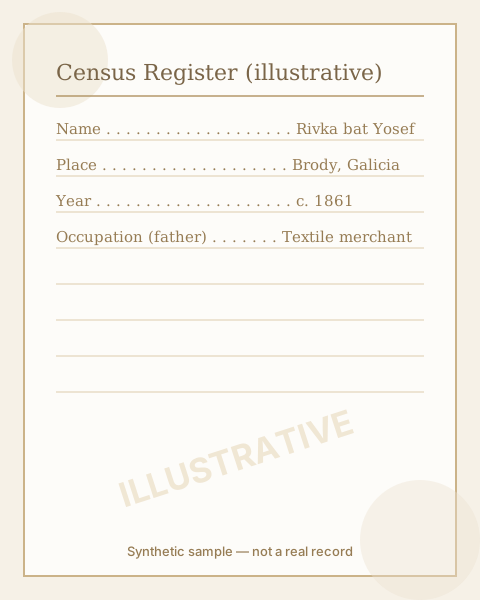
Illustrative archival census register — a synthetic sample, not a real historical document.
An 1880 census page is the kind of record that turns a route into a place. Illustrative.

Pricing

Start free. Always cited.

Your first kit is free — one fully cited ancestor narrative, no card required. Upgrade only if you want more kits and the full corpus.

Free Trial

$0
Start here

Your first DNA kit, on us — 1 upload

  • One cited ancestor narrative
  • Cross-vendor DNA consolidation
  • A real record image as proof
  • No card required
Choose Free Trial
Most popular

Pro

$29.99/month

Unlimited uploads + your family tree

  • Multi-kit consolidated narrative
  • Ancient-DNA deep origins
  • Records + timeline across vendors
  • PDF export
Choose Pro

One-Time

$49.99/one-time

One comprehensive report — no subscription

  • Everything in Pro
  • Full record-corpus deep search
  • Priority record retrieval
  • Unlimited kits
Choose One-Time

Features shown reflect the current build. See the full pricing page for current plans.

Your family took a route. Let’s draw it — and prove it.

Upload one DNA file. Get back a readable, fully cited line you can follow place by place. Your first kit is free.