
Archaeogenetics

Your line, traced back to ancient DNA — and told as a story.

The AADR ancient-DNA dataset is strongest for Eurasian and European lineages, where ancient samples are densely covered. Other services may show you a percentage; none narrate, for your specific maternal and paternal lines, how you connect to those samples. We weave it into your cited story, where the coverage exists.

Illustrative example — not real data
Illustrative — not real data

Genetic-distance proximity to ancient samples (AADR).

  • Central European burial, 9th c.92% proximity

    AADR sample I12345 · same maternal clade

  • Medieval European cluster78% proximity

    AADR cluster · shared drift

  • Bronze Age Steppe41% proximity

    AADR reference · deeper origin

Each proximity claim is footnoted to a specific AADR sample or cluster — never an unsourced “ancient ancestry” percentage.

What this means for your family

Deep origins you can read, not just a pie chart

Ancient samples, made personal

Your maternal and paternal haplogroups are connected to specific ancient individuals — a 9th-century European burial, a Bronze Age steppe sample — for your line, where ancient coverage exists.

Woven into the narrative

Ancient DNA isn't a separate tab. It appears as cited sentences in the same family story, right alongside the records.

Proximity you can cite

Genetic-distance proximity to AADR samples is shown as a number with a footnote — a claim you can check, not a vibe.

The bridge between deep and recent

It connects your documented 1800s ancestors to populations a thousand-plus years older, closing the gap most trees leave empty.

Honest about what it means

A proximity to an ancient sample is described carefully — shared deep ancestry, not a literal "your grandmother."

Updated as samples grow

As the AADR dataset adds samples relevant to your lineage, your deep-origin section can be refreshed and re-cited.
In the story

Ancient DNA as a cited sentence

In this illustrative excerpt, note the final sentence: an ancient Central European sample placed in the same maternal clade, footnoted to a specific AADR sample — not a vague percentage.

Illustrative — not real data

James McKinley

A paternal-line ancestor who settled the North Carolina backcountry, reconstructed step by step from a federal census, a colonial port book, a living DNA match, and an ancient genome — nothing guessed.

James was an established head of household in Rowan County, North Carolina, by about 1791 — Scots-Irish Presbyterian stock who came down the Great Wagon Road.[1] A generation earlier the line crossed the Atlantic: an ancestor departed Belfast in 1738 aboard the George and Anne.[2] A living descendant in Ballymena, County Antrim shares a 187 cM segment with your kit — a named, consented match that anchors the Ulster origin, not an estimate.[3] The direct paternal line carries Y-haplogroup R-L21, the dominant Atlantic-Celtic paternal lineage of Ireland and Britain.[4] That same R-L21 line turns up in the Rathlin Island ancient genome off the Antrim coast — a Bronze Age burial dated to roughly 2000 BCE, present on the island some four thousand years before the ship manifest.[5]

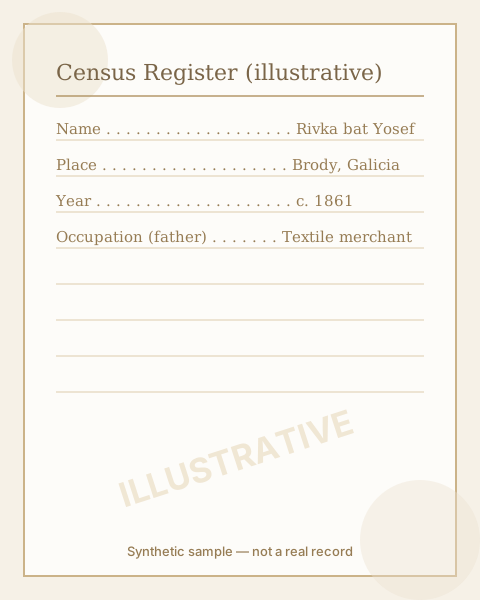
Illustrative federal census page showing James McKinley of Rowan County, North Carolina — a synthetic sample, not a real historical document.
Source verifiedIllustrative1800 U.S. Federal Census, Rowan County, NC (illustrative)
  1. [1]1800 U.S. Federal Census, Rowan County, NC
  2. [2]PRONI Belfast Port Books, 1738 — George and AnneView source
  3. [3]DNA match — 187 cM segment, Ballymena, Co. Antrim (consented)View source
  4. [4]Y-haplogroup R-L21 (Atlantic-Celtic paternal lineage)
  5. [5]Rathlin Island ancient genome, Ireland ~2000 BCE (Cassidy et al. 2016, Nature)View source

Continue this line back four more generations.

Unlock with your kit

The difference

Who narrates ancient DNA for your line?

ServiceWhat they doWhat we do
23andMeSurfaces ancient-DNA "matches" as a novelty percentage, with no narrative and no connection to your documented lineage.Tie specific ancient samples to your maternal/paternal line and narrate the connection, cited.
MyTrueAncestryCompares you to ancient samples in a standalone tool — powerful, but it never builds a sourced family story around the result.Fold AADR proximity into the same cited narrative as your records and living matches.
Ancestry / MyHeritageOffer no ancient-DNA integration at all — your deep origins simply aren't part of the product.Make archaeogenetics a first-class, footnoted part of your lineage.

They hold the ancient data. We turn it into your story — every connection sourced to a sample.

Start with your free kit

Add a DNA file or a GEDCOM and we begin building your sourced narrative — the first kit is free.